Free template
Marine job card template
What a marine job card should hold, and an annual service checklist for outboard and inboard diesel engines. Copy the lists into your own paperwork, or save them once as a routine job in KeelSync Service.
- Boat
- Solent Star
- Berth
- C14
- Engine
- Four-stroke outboard
- Engine hours, start
- 412
- Engine oil and oil filter changed
- Water pump impeller replaced to the maker’s interval
- Anodes checked, and replaced if worn
- Battery, terminals and charging checked
What goes on a marine job card
Twelve lines in two groups: the job, then the work. Write them on paper or save them in an app. Either way the card should say who it is for, which boat and engine, what was asked, what was done and what is left to do.
The lists are plain text, so you can copy them into your own paperwork.
The job
- Customer and a contact number
- Boat name, registration or hull number, and where it is berthed
- Engine make, model and serial number
- Engine hours at the start and at the end
- The work asked for, in the customer’s words
- Who is doing the job, and on what date
The work
- The steps, in order, ticked off as they are done
- Parts used, with part number and quantity
- Photos and notes of anything found
- Extra work, and who agreed to it
- Time spent on the job
- The engineer’s sign-off, and what to book next
Four-stroke outboard
A starting point. Always follow the engine maker’s service schedule.
Eleven steps, from the oil change to the test run. Tick them off on paper, or save the list as a routine job.
- Engine oil and oil filter changed
- Gearcase (lower unit) oil drained and checked for water or metal
- Spark plugs inspected, and replaced where the schedule says
- Fuel filter and water-separating filter changed or cleaned; fuel lines and primer bulb checked
- Water pump impeller replaced to the maker’s interval
- Propeller and shaft checked for damage and fishing line
- Anodes checked, and replaced if worn
- Grease points greased; throttle, shift and steering moved through full travel
- Battery, terminals and charging checked
- Test run: starts, idles, water flows from the tell-tale, no leaks, no alarms
- Hours recorded, and anything to book next added to the notes
An example, drawn for this page.
Inboard diesel
A starting point. Always follow the engine maker’s service schedule.
Eleven steps, from the oil change to the test run. Tick them off on paper, or save the list as a routine job.
- Engine oil and oil filter changed
- Fuel filters changed (primary and secondary) and the water separator drained
- Raw-water impeller checked, and replaced to the maker’s interval
- Coolant level and condition checked; heat exchanger and hoses inspected
- Drive belts checked for wear and tension
- Hoses and clips inspected, especially below the waterline; seacocks worked free and closed
- Anodes checked, and replaced if worn
- Gearbox oil level and condition checked; stern gland checked for drips
- Exhaust and mixing elbow inspected; engine mounts checked
- Battery, terminals and charging checked; bilge pump tested
- Test run, hours recorded, and anything to book next added to the notes
An example, drawn for this page.
Save the list once. Use it every time.
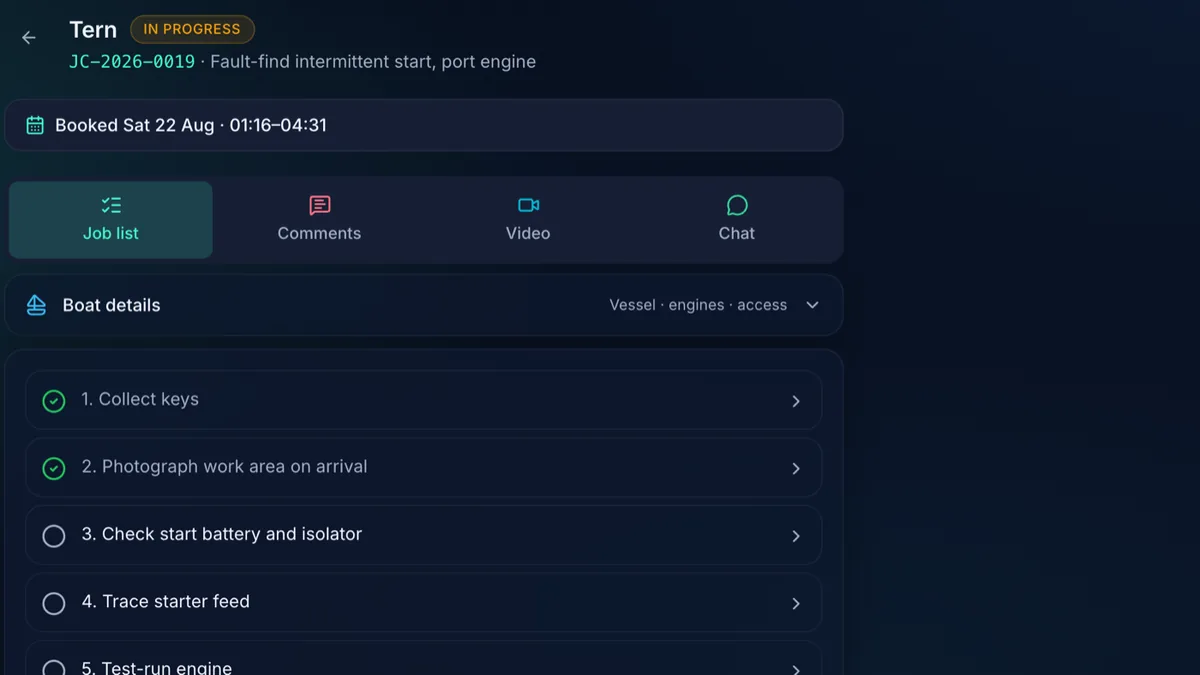
An annual service is the same list every time. Save a list like this as a routine job, with each line as a step. Drop the job on an engineer’s day and it reaches their phone a moment later, with the boat, the steps and your note.
- Once a job is open on their phone, the engineer ticks each step as they go, with or without a signal.
- Every service, part and photo is kept against the boat, and every clip for 24 months after you send the report, so you can see what was done, by whom and when.
- 1Engine oil and oil filter changedroutine
- 2Gearcase (lower unit) oil drained and checked for water or metalroutine
- 3Spark plugs inspected, and replaced where the schedule saysroutine
- 4Fuel filter and water-separating filter changed or cleaned; fuel lines and primer bulb checkedroutine
An example, drawn for this page.
Questions about marine job cards
What should a marine job card include?
The customer and a contact number, the boat and where it is berthed, the engine make, model and serial number, the engine hours, and the work asked for in the customer’s words. Then the steps in order, the parts used, photos and notes of anything found, any extra work and who agreed to it, the time spent, and the engineer’s sign-off with what to book next.
How often should a boat engine be serviced?
Most makers set service intervals by engine hours and by time, and an annual service is the usual minimum for a boat in regular use. Follow the schedule in the engine’s manual or from the maker. The lists on this page are a starting point.
Can I print this or copy it into a spreadsheet?
Yes. Copy the lists into a document or spreadsheet, or print the page. If you want the steps on the engineer’s phone, ticked off as they go and kept against the boat, save them as a routine job in KeelSync Service.
How do I use a checklist like this in KeelSync Service?
Save it once as a routine job, with each line as a step. Drop the job on an engineer’s day and it reaches their phone with the boat, the steps and your note. Once the job is open on the phone, the engineer ticks each step as they go, with or without a signal, and the ticked steps appear on the customer’s report.
Save your routine. Start your first job.
Two months free for up to 10 people, setup included, no card. Sign up with your work email and the app walks you through your company, your team and your first job.